When Seabourn launches its first of two purpose-built expedition ships it will not only be the smallest vessel in the ultra-luxury cruise line’s fleet, it will be the smallest in the Carnival Corporation stable of cruise brands.At 26,000 gross tonnes and with a capacity of 264-guests, Seabourn Venture (and her yet-to-be-named sister ship) will be just 170-metres in length and 10-decks high. Each will have around 225 team members, including 26 dedicated expedition crew, meaning a guest to crew ratio of almost 1:1.By comparison, Seabourn’s Odyssey-class ships (Seabourn Odyssey, Seabourn Quest and Seabourn Sojourn) carry around 450-passengers, and Seabourn Encore and Seabourn Ovation slightly more than 600.Subscribe to LATTE Cruise’s free eNewsletter to keep up to date with everything in the luxury cruise space.Robin West, Vice President and General Manager, Expeditions says the new ice-class ships are comparable in size to those Seabourn started with back in the late 80s – Pride, Legend and Spirit (which have since joined the Windstar Cruises fleet).In LATTE‘s second exclusive column with West, he discusses Seabourn’s expedition fleet hardware, brand new spaces, and state-of-the-art technology to access new regions of the world.
“With Seabourn Venture we’re creating a new and a very different product, but by no means are we creating a new brand,” West says.
“We wanted to be very specific with that so when we designed both the expedition ships our Seabourn Club Members who have cruised previously with us are instantly familiar with the ship when they step onboard.”Seabourn enlisted Adam Tihany to design the expedition fleet’s indoor and outdoor guest areas. Interiors “very much feel like a ski lodge – wooden floors, heavy furniture, leather, rivets, thick carpets and throws,” West explained.“We looked at a lot of other ship interiors and they resembled a five-star hotel anywhere in the world. We wanted to create a feeling inside of the vessel that was a tribute to the early explorers,” he said.
Old and New touchpoints
Popular venues have been carried over from Seabourn’s ocean fleet, such as the casual dining venue, The Colonnade, the fine dining Restaurant, the Seabourn Square cafe gathering point, and the Club.
Seabourn’s legacy venues carried over to Seabourn Venture: 1. The Colonnade / 2. The Restaurant / 3 and 4. Seabourn Square Cafe / 5. The Club
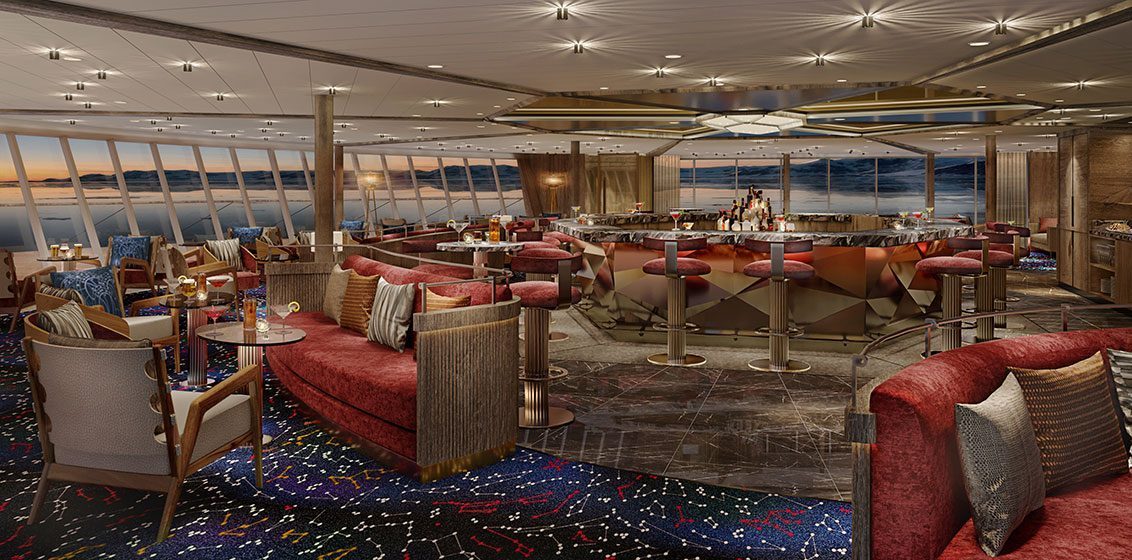
“There will be a lot of familiar touchpoints, but we have created several new public spaces in line with the product,” West said.These include the Bow Lounge and Bow Sprit, the Constellation Bar, the Expedition Lounge, dual Mudrooms and vast spaces of open deck.
“A lot of new expedition ships coming out today have really compromised on the amount of open deck space that is available. With Seabourn Venture we have nearly 3,000 square metres of deck space, which encourages guests to get out into the environment of the destinations we visit.”
“That is critical to delivering the products and to getting your guests out into the environment.”“We’ve got three or four beautiful open decks. On open sea days, such as crossing the Drake Passage to Antarctica when we’ve got southern giant petrels and albatrosses using the ships draft, guests will be able to stand on the outer decks and view these majestic birds at eye-level.”“When we designed the vessel we very much wanted to make sure that we could deliver on really what is a true expedition experience, beyond getting guests on the shore every day,” West added.
Bow Lounge and Bow Sprit
West says that unlike other expedition ships, Seabourn Venture will feature an outdoor platform at the forward-most part of the ship which is completely free of mooring equipment, called the Bow Sprit.“Other expedition lines have a hybrid bow because they don’t have space. On Seabourn Venture our bow is completely a public, open area. All the mooring equipment is one deck below, beneath the platform.”On Deck 6, the Bow Sprit is accessed via the Bow Lounge, perhaps the venue that excites West the most as it brings guests into the operation hub of the ship, in addition to Seabourn Venture‘s open bridge policy.
“We’ve almost created a virtual bridge with the Bow Lounge which is forward-facing and features three consoles, each with four screens, which replicates what we have on the bridge.”Those displays include navigational charts, a real-time live feed to the ship’s radar, water depth, wind speed, rate of turn, rudders and technical data, and a link to the outside cameras, including a 4K Cineflex camera mounted on the mast.“That’s an extremely high-tech piece of equipment that can zoom in on a polar bear three- or four-miles away, telecasting the visual back to TV screens onboard the ship.”The Bow Lounge also offers a collection of iPads guests can use to find additional information about the destinations they are visiting and apps to look at ice charts and weather charts, and there’s combination of a seated, relaxing area and some self-service snacks available.“For me, and from an operational perspective, the Bow Lounge is one of the most exciting areas on the ship.”
Landing Zone, Expedition Lounge and Discovery Centre
Both expedition ships will feature dual “Landing Zones” (mudrooms) located on the port and starboard sides of Deck 3. It’s the venue guests will meet before disembarking on Zodiacs or sea kayaks (from Deck 2) for a water activity or shore excursion, and the first place they return to when stepping back on board. In the mudroom, each guest will have access to their own locker for the duration of the cruise where they can store walking poles, rubber boots for polar expeditions or snorkelling gear when in the tropics.
The Expedition Lounge is one floor up. This is an all-new space for Seabourn which West says will be “the heart of the vessel” during operational days. An area where guests will congregate prior to heading down to the mudrooms, and an area to relax and share photographs with other guests after an outing.
Adjacent to the Expedition Lounge will be the Discovery Centre, a teaching and academic centre where guests will participate in lectures, briefings and the Seabourn Conversations enrichment program. The venue is large enough to accommodate all 264 guests and features 10metre wide HD monitors which, amongst other things, will playback footage from the days submarine dives.
Bow Thrusters and Azipods
Seabourn Venture and sister ship will be the only vessels with three bow thrusters, an ice-strengthened hull, and an azipod propulsion system that rotates 360 degrees, as opposed to a fixed rudder/propellor combination.“On an expedition vessel when you are operating in heavy ice you have to slow down. On any ship the more you slow down, the more you lose steering capabilities. You don’t have the ability to steer and have full control of the vessel if there’s wind.”“But with an azipod they can move the ship in any direction – you’re not relying on the speed of the vessel. Between the azipods and the bow thrusters, when we’re in ice, regardless of the weather conditions, the ship will be 100% maneuverable and under control.”
“What a lot of people don’t realise is a lot of time that you want to do ice cruising you need good conditions if you have fixed rudders, cause you don’t have as great control in the ice and the ship is pushed in directions the captain can’t control. So the azipod gives the vessel a fantastic amount of control.”Sebourn Venture will also be the first Seabourn ship with full DPS (dynamic positioning system), meaning wherever the ship goes it will never have to drop anchor.Guests will have the opportunity to step directly onto “fast ice” in polar regions via a gangway from a door strategically placed far forward, and at water level.Additionally, Seabourn Venture is built with an extended range capabilities, or extended autonomy. “For a cruise beyond three weeks at sea this vessel can be completely isolated and totally self-contained without any outside resources required. That allows us to explore regions such as the Northeast and Northwest Passage.”“It allows us to do itineraries not just going up to Manaus , but all the way from Manaus up to Iquitos where you have limited resources along the way, and not always the opportunity for bunking or provisioning,” West explained.Find out more about the itineraries Seabourn Venture will explore in her maiden season in LATTE’s next Spotlight Feature with Seabourn.Lead image: The Constellation Lounge, another new venue on Seabourn’s expedition fleet, features wrap-around floor-to-ceiling glass walls and will be the highest indoor viewing point on each vessel.
All images courtesy of Seabourn.